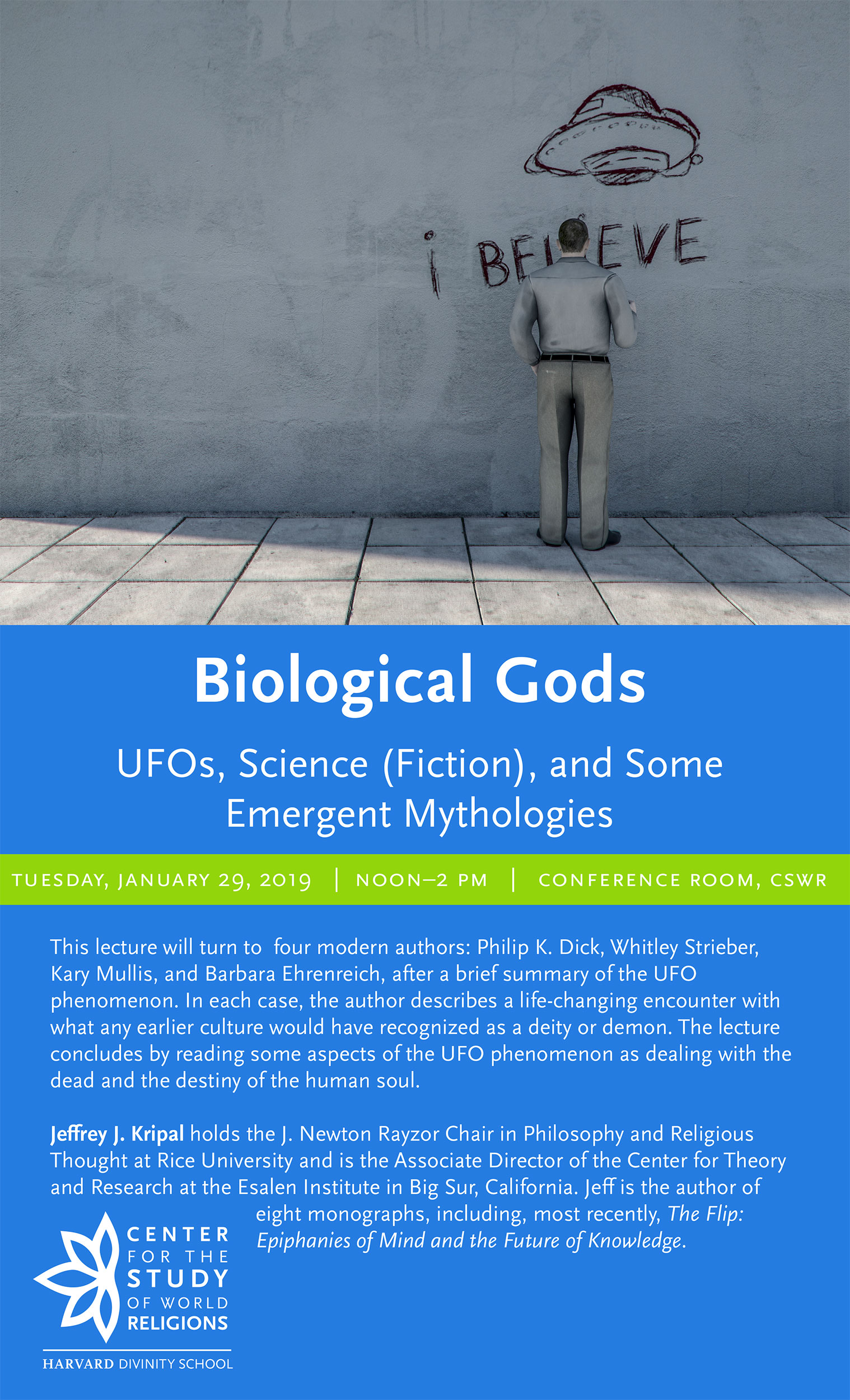


You Can Keep My Things They’ve Come to Take Me Home, used with permission of Michael Prettyman.
My present and future work is focused on the conception and writing of the Super Story Trilogy, itself deeply dependent on the Archives of the Impossible. Both are worth describing here. There are three basic components to the trilogy project: (1) cosmology and quantum physics; (2) evolutionary biology; and (3) technology and eschatology, particularly as these are expressed through the UFO phenomenon and the entheogenic molecules. The trilogy as a whole is entitled The Super Story: Science (Fiction) and Some Emergent Mythologies.
At the moment, the three volumes are entitled:
- The Physics of Mystics: Thinking Impossibly after Religion and Science
- Biological Gods: Evolution and the Coming Superhumans
- The Soul Is a UFO: The Bomb, Technology, and the End of All Things
I teach and lecture on these ideas regularly now in both the U.S. and Europe. I also work every morning on these three volumes, which are further along than I am willing to admit.
The Super Story is a poetic device designed to embrace all of those emergent mythologies and mystical currents that have been developing over the last two centuries in deep conversation with the sciences, particularly (1) cosmology, mathematics, and quantum physics, (2) evolutionary biology and (3) technology. Apocalypse as Disclosure (the two words literally mean the same thing) is as much about the “end of the world” as it is about the “revelation of the real.” Both are emphasized here. The Super Story trilogy will move through these scientific complexes (physics, biology, and technology) and explore the various ways that such sciences are radically altering our understanding of human nature and the cosmos itself and, alternatively, how they themselves are often secretly informed by the anomalous or paranormal experiences of the scientists themselves. Wolfgang Pauli, for example, was a major architect of quantum physics. He was also a walking poltergeist and the man who helped C. G. Jung forge “synchronicity.” This is the idea that meaning is not reducible to social or historical context but is sometimes woven into physical reality itself and is particularly apparent in altered states of consciousness and energy.
Such a trilogy is “super” in this sense: it foregrounds or emphasizes those moments of “transcendence,” in this case a kind of vertical dimension that cannot be slotted into the two-dimensional flatlands of society and science.